
THE SEVEN APPOINTED TIMES
Key Point: The Order Of These Feast Can Never Be Rearranged
God spoke to Moses during Israel’s wilderness journey and established seven major feasts, which are called moedim, or “appointed times.” Seasons were marked and celebrated each year, and were to be perpetual from generation to generation.
“And the LORD spoke to Moses, saying, “Speak to the children of Israel, and say to them: ‘The feasts of the LORD, which you shall proclaim to be holy convocations, these are My feasts.”
– LEVITICUS 23:1-2 (NKJV)
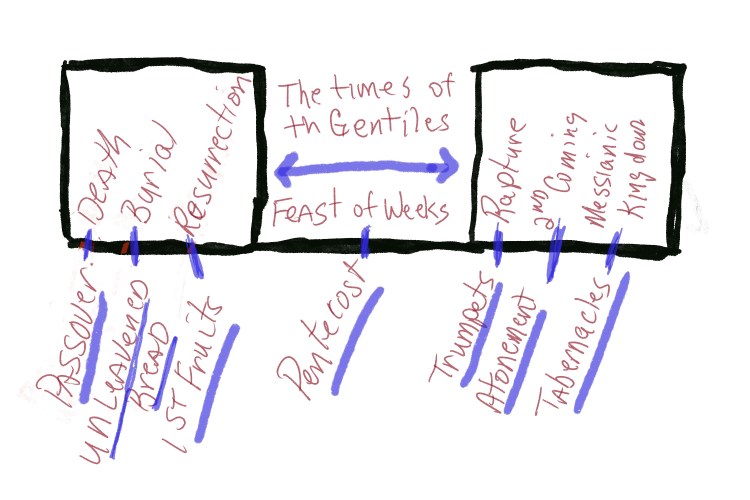
The feast is an appointment or fixed time. We think of a feast as a huge banquet where everyone is eating until they cannot eat another bite. However, during one of Israel’s seven feasts, Yom Kippur, also known as the Day of Atonement, the people fasted instead of feasted.
These feasts were also called a convocation; the Hebrew word being mikraw (Lev. 23:3, 7, 8), which means a public meeting or a rehearsal.
What is the “Prophetic” significance of these Feasts? Jewish people did not seem to realize is that all of The Feast Of The Lord were also symbolic types. In other words, they were “Prophetic In Nature,” each one pointing in a unique way to some aspect of the Life and Work of the Promised Messiah:
The Spring Feast
1) Passover… pointed to the Messiah as our Passover Lamb whose blood would be shed for our sins. Jesus as Messiah, was crucified on the day of preparation for the Passover, at the same time that the lambs were being slaughtered for the Passover meal that evening.
2) Unleavened Bread… pointed to the Messiah’s sinless life, making Him the perfect sacrifice for our sins. Jesus’ body was in the grave during the first days of this feast, like a kernel of wheat planted and waiting to burst forth as the bread of life.
3) First Fruits… pointed to the Messiah’s resurrection as the first fruits of the righteous. Jesus was resurrected on this very day, which is one of the reasons that Paul refers to him in 1 Corinthians 15:20 as the “First Fruits From The Dead.”
The Summer Season
4) Harvest – Shavuot or Pentecost… pointed to the great harvest of souls, both Jew and Gentile that would come into the Kingdom of God during the Church Age. The Church was actually established on this day when the Messiah poured out the Holy Spirit and 3,000 souls responded to Peter’s first proclamation of the Gospel.
The long interval of three months between Harvest and Trumpets pointed to the current Church Age, “The Feast Of Weeks” a period of time that was kept as a mystery to the Hebrew prophets in Old Testament times.
Prophetically , this is the hour we are in…. “The Weeks Of Harvest”
In the this time period in the natural , we have the Early Rain or Former Rain and the Latter Rain at Harvest time… We are in the Seasons Of the Latter Rain…. In Zechariah 10:1 we are told to “Ask Of Lord Rain In the Time Of The Latter Rain …. and in Joel 2 we have the Promise Of the Double Portion Outpouring… The Former and the Latter Rain Poured out together.
The Fall Feasts
That leaves us with the last three (fall) Feasts which are yet to be fulfilled in the life and work of Jesus the Messiah… Because Jesus literally fulfilled the first 4 feasts and did so on the actual feast days, I think it is safe to assume that the last three will also be fulfilled and that their fulfilment will occur on the actual feast days. I cannot be certain how they will be fulfilled, but my guess is that they most likely have the following prophetic implications:
Rosh HaShanah / Trumpets — points to the Rapture ( Catching Away Of The Bride) when the Messiah will appear in the heavens as a Bridegroom coming for His bride, the Church. The Rapture is always associated in Scripture with… the blowing of a loud trumpet!
The Feast has so many parallels with Jesus return for His Bride as laid out in 1 Corinthians 15:52. Firstly, the Feast Of Trumpets is the only Feast Of The Lord that starts with the New Moon. What is the New Moon …. The very first sliver of the moon… Now the The feast of Trumpets would start in a 48 hour window. The Jews did not know whether the Feast of Tishri would start on the 30th of Elul or actually Tishri 1.
It would begin on one of these two days. They also did not know at what hour the Feast of Trumpets would begin on whichever day it started. The words of Jesus thus fit well into the determining of the New Moon for the start Of Tishri 1, i.e., the Feast of Trumpets. This was extremely important because determining the right date would mean that the Seven Days of Awe (Time Of Jacobs Trouble) between Feast Of Trumpets and the Day of Atonement ( The Second Coming Of Jesus) would also be celebrated on the proper day, and these were the High Holidays of The Lord ( Lev 23:1;2)
The Feast of Trumpets (Tishri 1), Day of Atonement (Tishri 10) and the Feast of Tabernacles (Tishri 15-22). Thus, Jesus may very well have been speaking of this situation when He said,
Matthew 24:35 Heaven and earth shall pass away, but my words shall not pass away.
36 But of THAT DAY AND HOUR knoweth no man, no, not the angels of heaven, but my Father only.
(1 Thessalonians 4:13-18; 1 Corinthians 15:52; Mathew 24:35)
Here is Summary of reasons why we should expect to see the Rapture (The Catching Away Of The Church ) happen on the Feast of Trumpets / Rosh Hashanna
1. All the Spring Feasts were fulfilled at Christ’s first coming, and on the exact day of the feast. All the Fall Feasts picture the second advent, and the Feast of Trumpets is the first of the fall feasts, picturing the rapture.
2. The Feast of Trumpets is when the “Last Trump” of the rapture of 1 Cor 15 is blown. The 100 Shofar blast and the 100th blast is the Tekiah Gedolah which is known as the Last Trump and is a long held blast of note as long as the Trumper can hold his breath on it.
3. The Feast of Trumpets is known as the Wedding of the Messiah, and the Church is the Bride of Christ, and the rapture is when the Church is caught up to heaven to be wed with Christ.
4. The Feast of Trumpets happens on the “new moon”, which is 29.5 days after the last one, meaning it might occur on the 29th or 30th day, nobody knows for sure. “Of that day or hour no man knows” is an expression referring to this feast, and thus, the rapture.
5. “Of that day or hour no man knows, but my Father only” is an expression used by a groom when asked when his wedding will be. He says this because it is his Father that will tell him when his preparations on the bridal chamber are completed and it is time. Again, the wedding pictures the Rapture.
6. The “Open Door” of the rapture in Matt 25, and Rev 3, & Rev 4:1 is a symbol of the Feast of Trumpets. [Ezek 46:1] “Thus says the Lord GOD: The gate of the inner court that faces east shall be shut on the six working days; but on the sabbath day it shall be opened and on the day of the new moon it shall be opened.
7. We are told that the new moon and the Feasts of the Lord are a shadow of things to come in Col 2:16,17. Since the Feast of Trumpets is the only Feast of the Lord that falls on a new moon, we should take particular note.
8. There are seven days of awe (The Time Of Jacobs Trouble) in between the Feast of Trumpets and the Day of Atonement. These picture the seven years of tribulation. Atonement pictures Satan being defeated and cast away at the end of tribulaion. If you add the two day Trumpets feast, and the day of atonement, the 7 days of awe are “days of tribulation” which might be referred to in Rev. 2:10
9. In the Jewish Wedding, a marriage takes place over a period of time known as the “bridal week”. During the bridal week, the groom and bride consummate their marriage in the bridal chamber. At the end of the week, there is a marriage supper. Compare Judges 14, Rev. 19, and Gen. Genesis 29:22-28 This bridal week will be the tribulation week on earth, while the bride of Christ is in heaven.
10. In the Jewish Wedding, the groom comes for his bride “like a thief in the night” to take (siege/rapture) her away and into the bridal chamber for the bridal week at his father’s house.
11. The Feast of Trumpets is also known as the coronation of the Messiah, when he will start reigning as king, thus the beginning of the “Day of the Lord”, which includes the tribulation.
12. It is also time for the bema judgment, or the judgement of the works of the righteous, and judgement must begin at the house of the Lord. [2Cor 11:2] For I am jealous over you with godly jealousy: for I have espoused you to one husband, that I may present you as a chaste virgin to Christ.
Feast of Atonement
6) Yom Kippur / Atonement… points to the day of the Second Coming of Messiah when He will return to earth. That will be the Day of Atonement for the Jewish remnant when they “look upon Him whom they have pierced,” repent of their sins, and receive Him as their Messiah. (Zechariah 12:10; Romans 11:1-6; 25-36)
Feast of Tabernacles
7) Sukkot / Tabernacles — points to the Lord’s promise that He will once again tabernacle with His people when He returns to reign over all the world from Jerusalem. (Micah 4:1-7)
#revival #awakening #feastofthelord #catchingawayofthechurch
 The Illuminated Path